

Written by Katya Rowny
French novelist Marcel Proust stated, “The real voyage of discovery consists not in seeking new landscapes, but in having new eyes.” I love this quote because it encapsulates what traveling can offer us, and with a camera in hand, what it can capture for years to come.
Traveling to different countries or even different cities can help us harness a sense of adventure and intrigue, but traveling with film gear shouldn’t be about carrying a heavy camera bag; it’s about choosing a reliable, compact companion that won’t weigh you down.
Whether you’re wandering through city streets, hiking mountains, or capturing everyday life in a different city, the best travel film cameras are those that balance quality with simplicity. Below, we’ll look at three excellent travel-ready cameras, each praised for their portability and ease of use.

1. Olympus XA2
Of course, we will begin with my favorite full-frame 35mm point and shoot, the Olympus XA2. Although there are four cameras in the XA line up, I have only used the XA2. I often joke that this camera is a point and shoot plus, offering a few controls to tweak.
Weighing roughly 212g, the Olympus XA2 is the perfect balance between quality and convenience. The camera embodies the genius of designer Yoshihisa Maitani, the visionary behind some of Olympus’s most iconic compact cameras. This small, clamshell-style 35mm camera slips easily into a jacket pocket, ready to go wherever you do.
The XA2 features a sharp 35mm f/3.5 lens paired with a simple three-zone focus system — portrait, group, and landscape — making it intuitive even for beginners. Its automatic exposure system handles most lighting situations with ease, letting you concentrate on timing and composition rather than technical adjustments.

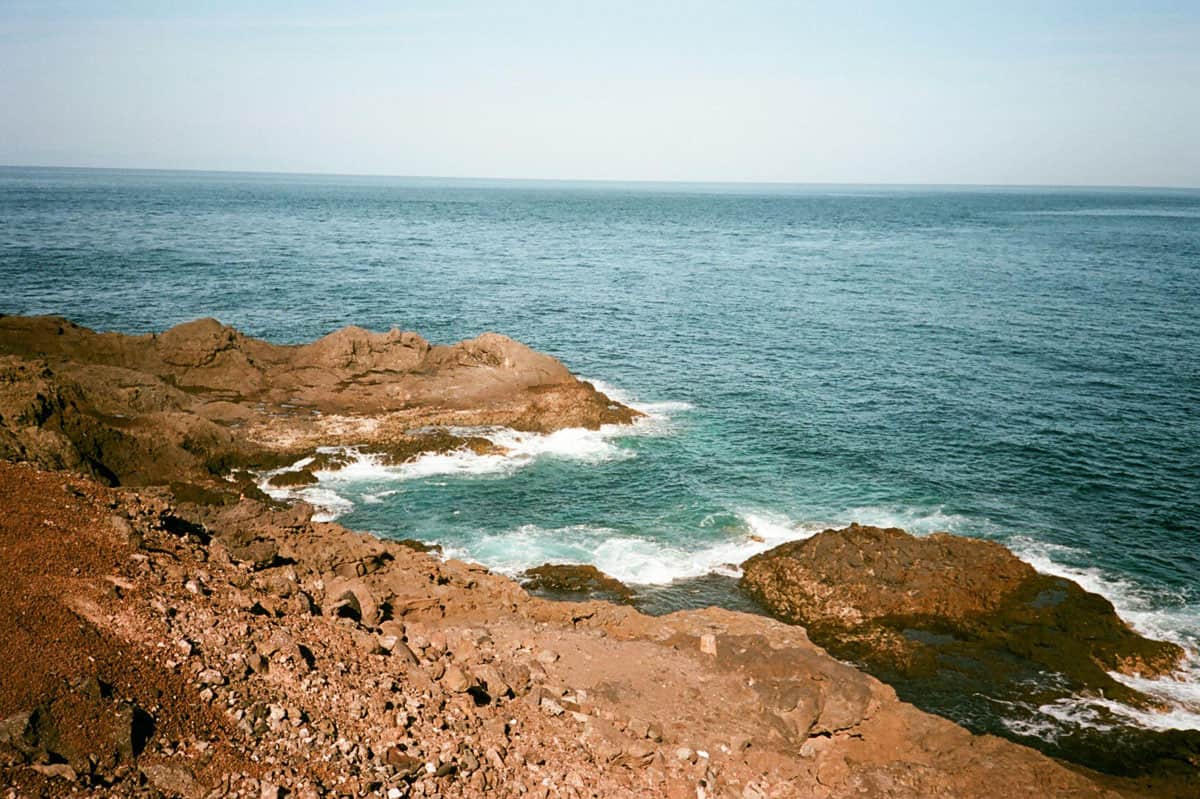


Compact yet sturdy, the XA2 seemed to be built for travel. The clamshell cover protects the lens and viewfinder, making it a reliable everyday companion, especially in unpredictable environments.
This camera has traveled with me to the waterfalls of Costa Rica, the streets of Belize and even a bicycle tour in the Canary Islands. Lightweight, pocket-sized, and discreet, it’s the kind of camera you can carry all day without noticing it’s there and it’s easy to use when the moment appears.
The XA2 isn’t without its quirks, though. Some older units can develop light leaks or minor electronic issues, and the lack of manual controls may frustrate photographers who prefer fine-tuning their settings. Still, for travelers who value portability and simplicity over technical control, the Olympus XA2 remains a hard-to-beat companion.
You can read more about the Olympus XA2 here, and pick one up for yourself at KEH Camera or on eBay.


2. Kodak Ektar H35N
For travelers who want to pack light and shoot often, the Kodak Ektar H35N is a fresh and fun companion. This modern half-frame film camera captures two images per standard 35mm frame, giving you 72 exposures on a 36-exposure roll — double the shooting time without adding any extra bulk.
Weighing just over 100 grams, the H35N feels almost weightless and slips easily into a small bag or pocket. Its glass lens is a welcome upgrade from earlier plastic-lens half-frame models, delivering cleaner, sharper results.
Despite its simplicity, it also includes creative features like a built-in star filter, bulb mode, and tripod mount, which make it more versatile than you might expect.


As noted in this Shoot It With Film review, the Kodak Ektar H35N is designed for casual, carefree shooting. It performs best in bright outdoor light, where its fixed 1/100-second shutter speed and narrow aperture deliver crisp, punchy images with that nostalgic half-frame charm.
Lightweight, portable, and endlessly easy to use, it’s ideal for everyday documentation and travel snapshots alike. This camera has traveled with me to different countries, and I’m always pleasantly surprised with the sharp (often forgotten) results because it takes me longer to shoot through the entire 72 frame roll.
Of course, that portability comes with some trade-offs. Half-frame negatives are smaller, which means scans and enlargements can show more grain and less resolution.
The camera also struggles in dim or indoor lighting. Still, for daylight adventures and ease of use, the Kodak Ektar H35N captures the joy of film photography in its simplest, most travel-friendly form.
You can find the Kodak Ektar H35N on Amazon here.


3. Holga 120
Last but not least, I recommend the Holga for those wanting to shoot medium format without worry. This camera is a cult favorite among film photographers — and for good reason. It’s lightweight, affordable, and delightfully unpredictable.
Made with a simple plastic body and minimal internal mechanics, the Holga is the opposite of a precision tool — and that’s exactly what makes it so appealing for travel.
When exploring new places, not every shot needs to be perfect. The Holga’s quirks — soft focus, heavy vignetting, and the occasional light leak — lend images a nostalgic, dreamlike quality that turns ordinary scenes into something atmospheric and textured.
Having multiple cameras in the Holga lineup, some with a glass lens, like the Holga 120GCFN and a newer model on the scene, the GNP, made by The Daily Holga’s very own Alec Pain, the variety and options for modification are almost endless.


The Holga 120GCFN, featuring a glass lens with a flash option, has traveled with me to many different countries, no worse for the wear. I have unfortunately dropped this camera, banged this camera and all around been a bit rough with it, and been relieved that it has withstood all of my foolishness.
It’s inexpensive and nearly indestructible, you can toss it in a bag, take risks, and shoot freely without worrying about scratches or a terrible loss — a liberating feeling for travelers used to guarding their gear in unknown places.
Of course, that freedom comes with trade-offs. The Holga’s simplicity brings inconsistency: lenses vary in sharpness, vignetting is almost always present, and exposure control is minimal at best.
This camera is not built for technical precision or critical documentation. You’ll get the best results with good light, a forgiving film stock and a willingness to try something different.
For travelers who value spontaneity over control and see photography as a creative experiment rather than a technical pursuit, the Holga is an ideal companion. It’s a joyful, low-stress camera that captures not just what a place looks like, but how it feels.
You can read more about the Holga here, and you can pick one up on Amazon here.


Travel film photography is about slowing down and noticing — the way light falls across a street, the color of a distant horizon, the fleeting details of a new place.
The best travel camera is one you’ll actually use, one that fits easily into your day and helps you stay in the moment. Each of these cameras encourages what travel should be: curious, spontaneous, and full of discovery.

Thank you so much, Katya! Katya is a regular contributor for Shoot It With Film, and you can check out her other articles here, such as Chrome, Grain, & Nostalgia: Tips for Photographing Cars on Film and The Top 3 Film Labs I Trust With My Work (And Why I Keep Going Back).
You can also find more of Katya’s work on her website and Instagram.
Let us know your favorite film cameras to travel with below in the comments!


Leave a Comment
Shoot It With Film on Instagram


Blog Comments
Eddy
November 14, 2025 at 11:00 am
Nice photos. I love my Olympus XA 1 and 2. My samsung Evocas and My Pentax !Q zooms. I also keep a vivitar tec 45 and my newly acquired Konica Mg cameras in my car. Now if your H35N has a flash which it does why would you struggle with dim or indoor lighting then? Or are you one of the Film photographers who refuse to use flash and would rather pull highlights in photoshop because of underexposure? I follow many film youtubeographers who follow that mentality.
Katya
November 15, 2025 at 2:34 pm
Hi Eddy! Sounds like you have a nice collection of cameras! I’ve heard good things about the Pentax IQ zooms. Yes, the H35N does have a flash, I just meant its inconsistent in low light situations. I think most of the time I forget the flash is on the camera and forget to turn it on. I don’t own photoshop and only do basic editing such as crop and straightening. Thanks so much for reading and commenting!
Danny
November 14, 2025 at 1:55 pm
Smena 8M is in my pocket when I’m in a foreign land. It uses no batteries, has full manual control, and a 40mm surprisingly good lens. Sure it has quirks but there’s a reason it’s the biggest – selling camera in the world with 21 million sold. Durability is needed when you have only one chance to get the shot before going home.
Katya
November 15, 2025 at 2:36 pm
Hi Danny! I’ve heard of this camera and actually own one! It’s been sitting on my shelf and I’m not even sure it works?! Sounds like its a nice camera with a sharp lens. Thanks so much for commenting and reminding me about this little gem.
DeWayne Carver
November 14, 2025 at 3:55 pm
Great post! I see in your photo you also use a Rolleiflex, and I don’t see any stories from you about traveling with that! Have you used your Rolleiflex as a travel camera, and if so, how did you find it? Any tips or tricks for those of us who occasionally haul one of those beasts around?
Katya
November 15, 2025 at 2:40 pm
Hi Dewayne! Thanks so much for your comment! The camera in my profile photo is a Yashica D. I wish I had a Rolleiflex but not yet 🙂 I own a Minolta Autocord also. I have traveled with both of them in my carry on with a protective camera wrap that clings to the camera and helps keep it safe. I also use the neck straps that come with the cameras as a an added layer of caution. I hope this helps! Thanks again for commenting!
Ray Goulter
November 14, 2025 at 6:43 pm
Good discussion on the three cameras. The Olympus Trip35 is another great full-frame 35mm film camera for taking on holidays. It has a fantastic fixed 40mm lens comparable in sharpness to its Leica equivalent (and that’s saying something!) and its light metering system doesn’t require batteries and works perfectly.
Katya
November 15, 2025 at 2:41 pm
HI Ray!
Ooooh, yes I’ve heard of the Olympus Trip 35! Sounds like a keeper with the 40mm lens! Might have to add it to my christmas wish list : ) Thanks for reading and commenting!
Jochen
November 14, 2025 at 11:11 pm
In the 1980 years I used the Minox 35GT with a 35mm/2,8 Tessar-type lens as smallest possible 35mm camera.
Until 2010 I shoot analog, for travelling and architecture, a very handsome system camera was the Contax G2 by Yashica with a complete set of Zeiss lenses from 16mm Hologon 2 to 90mm SOnnar. It had a zooming rangefinder and an intelligent fast autofocus. It was much lighter and easier than my Nikon F90X set.
Since 3 years now I mostly use the Nikon 1 system.
Katya
November 15, 2025 at 2:44 pm
Hi Jochen!
I’ve heard of the little Minox cameras! I actually own two, but haven’t had any luck with either of them yet. I did get one repaired so maybe it works now? I’ll have to try them again. I think they are the EL an PL versions. I’ve heard and seen great results from the Conax series. Never tried it myself but maybe one day?? My digital kit is a Nikon and I love it : ) It makes life easier using 1 system I think. Thanks for commenting!