

Written by Katya Rowny
When I started shooting film years ago, using different cameras became a slippery slope for me. From using manual focus lenses, to understanding the exposure triangle, I realized that if I wanted to keep film photography an enjoyable hobby, I needed an easier route.
Enter point and shoot cameras.
I remember feeling quite shy about my love of these simple no nonsense cameras, thinking that maybe it made me “less” of a film photographer if I wasn’t always calculating the shutter speed or aperture with every shot. Thankfully, as the years have progressed and I have amassed a collection of cameras in various states of disrepair, my love for the simplistic cameras has only grown.
In my last article, I went over three of my favorite point and shoot cameras, and, in this article, I’m going to share a few more that have helped propel my love of this hobby.

1. Canon Sure Shot 105 Zoom
First up is the Canon Sure Shot 105 Zoom (find on eBay). This camera was gifted to me by a family member when they found out about my obsession–I mean love–of film. They shipped the camera across the United States along with some expired film.
The Canon Sure Shot 105 Zoom (also known as the Prima Zoom 105 or Autoboy Luna in some markets) is a fully automatic late-1990s 35mm point-and-shoot.
This camera features a 38–105mm f/3.8–8.9 Canon zoom lens, autofocus system, and fully automatic exposure control, along with automatic film loading, advance, and rewind. The camera supports DX-coded film (25 to 3200) for automatic ISO detection and includes a built-in flash with multiple modes such as auto, fill-in, and red-eye reduction.
A self-timer and simple knob control on top of the camera make it easy to handle everyday shooting without needing any manual adjustments. In summary, this camera is the epitome of point and shoot.


What makes the Sure Shot 105 Zoom appealing is its balance of simplicity and versatility. The 38–105mm zoom range allows users to switch from wider environmental shots to tighter portraits without changing lenses, making it a practical all-in-one travel camera.
Canon’s 3 point autofocus uses AiAF (Artificial Intelligence Autofocus) and uses a fully automatic exposure system with 3-zone metering, which means it reads light from different parts of the scene to help produce a well-balanced photo. It can handle a wide range of lighting conditions, with a metering range from EV 3 to EV 19.
The camera automatically sets the shutter speed and aperture for you, so you don’t need to worry about manual adjustments. It also offers a special “Real Time” (RT) mode that’s designed to reduce shutter lag. Pretty inventive for the ‘90s!
If you happen to stumble upon this camera, I highly recommend you bring it home and enjoy how easy and no fuss this camera is.
Find the Canon Sure Shot 105 Zoom on eBay.


2. Pentax PC 35AF-M
Next up on the list is a camera I bought a few years ago at a local swap meet, the Pentax PC 35AF-M (find on eBay). As always, I was initially intrigued by the red shutter button. I wish I could remember the exact price I paid, but nevertheless that’s the day the Pentax PC 35AF-M came home with me.
This camera is a little tank, she’s a bit on the chunky side around 340 grams and takes 2 AA batteries to operate. Released in 1984 as an upgraded version of the original PC35AF, it combined Pentax’s sharp 35mm f/2.8 lens with several improvements that make everyday photography easier. A built-in motor drive automatically advances the film after each shot, while DX coding detects the film’s ISO automatically, with the option to manually set the ISO when using non-DX-coded film on the bottom of the camera.
The camera also features infrared autofocus, programmed auto exposure, a built-in flash, and a self-timer, making it a reliable grab-and-go camera for beginners and experienced film photographers alike. There’s a 2-step process to rewind the film using a button and lever on the bottom of the camera.


What continues to make the PC35AF-M popular today is its excellent image quality. Its fast 35mm f/2.8 lens delivers sharp photos with rich contrast and vibrant colors that easily compete with many better-known compact cameras.
Unlike many later point-and-shoots, the flash doesn’t automatically fire in every low-light situation, giving photographers a little more creative control.
One feature I really like on the PC35AF-M is its backlight compensation switch. Conveniently located on the top of the camera, it adds 1.5 stops of exposure at the press of a button, helping brighten subjects that would otherwise appear too dark when they’re backlit. It’s a simple feature, but one that gives you a little extra control when shooting in tricky lighting conditions.
It is not a quiet and discreet camera by any means, everyone will know when you fire the shutter or rewind the film, but hey, if you’re into nostalgia, this camera is for you!
One downside I would like to note is the battery compartment door doesn’t age well, and I ended up taping mine to ensure the batteries would stay put. For being a 42 year old camera, it does amazingly well and offers fantastic results.
Find the Pentax PC 35AF-M on eBay.


3. Olympus Infinity Mini
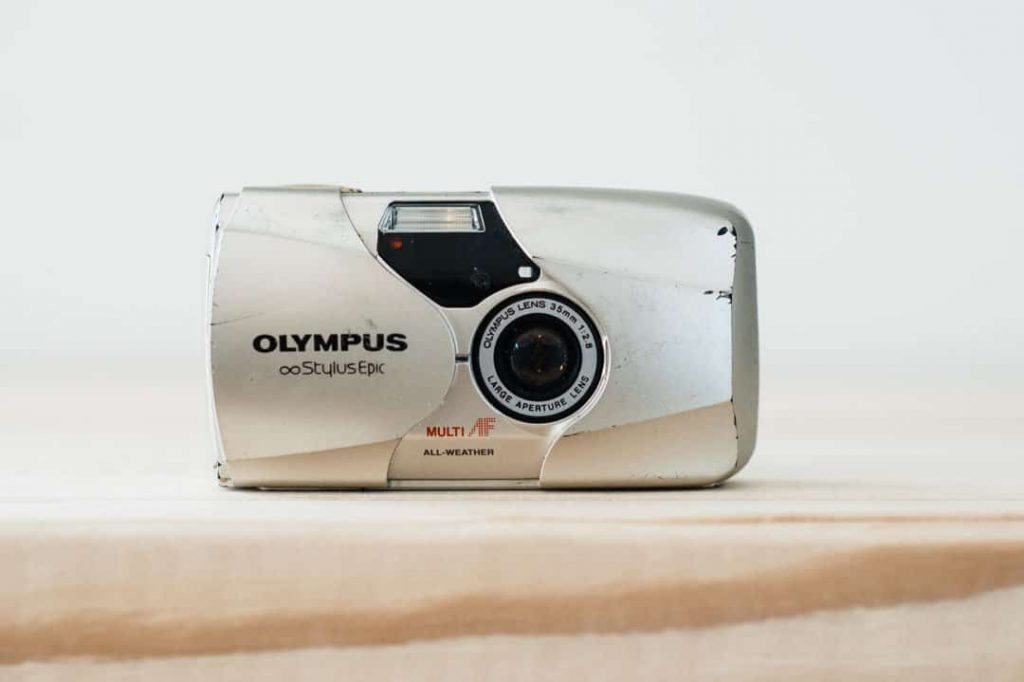
Last but not least, one of my most treasured cameras – the Olympus Infinity Mini. I ended up finding this camera in a dresser drawer at an estate sale years ago and thankfully the owner sold it to me for under $30.
The Olympus Infinity Mini is a compact, fully automatic 35mm point-and-shoot introduced in 1995. Known as the AF-1 Mini outside the U.S. and the OZ 1 in Japan, it was designed to sit between Olympus’s entry-level Trip series and the premium Mju line.
Despite its affordable price, it shares many of the same features as the original Mju 1, including a sharp 35mm f/3.5 lens, active autofocus with focus lock, programmed auto exposure, automatic film loading and rewinding, DX-coded film detection, and multiple flash modes.
Its sliding lens cover doubles as the power switch, and the weatherproof body is built to handle light rain and splashes, making it an easy camera to take just about anywhere.


What makes the Infinity Mini such a great find today is how much performance it offers for the price. The 35mm lens delivers sharp images with vibrant colors and pleasing contrast, producing results that are often compared to the much more expensive Olympus Mju-1. Its ergonomic design makes it quick to shoot—just slide the cover open, let the autofocus lock, and press the shutter.
A downside to using this camera is that the flash resets each time the camera is powered on, making the user cycle through the different options to turn the flash off. Another complaint, although fixable with, you guessed it, tape, is the battery door compartment. Unfortunately mine did not latch well even when I bought the camera, so my camera is always sporting the blue tape when I use it.
Overall, this camera is a dream to use. Its lightweight, quiet, easy to use, offers a reliable autofocus, and fits comfortably in your hands, the Olympus Infinity Mini remains one of the best hidden gems in the world of compact 35mm film cameras.
Find the Olympus Infinity Mini at KEH Camera or on eBay.


Whether you’re new to film or an experienced photographer, don’t let anyone tell you that you’re less of a photographer for using a point-and-shoot. These cameras aren’t lesser for being easier to use; on the contrary, the ease and accessibility of a point-and-shoot can give you the creative freedom to focus on your composition, your subject, or even just being in the moment.
Your photography journey is your own making, whether using “cheap” cameras or expensive ones. All that matters is that you take the shot and capture the memories.
So tell me, which point and shoot are you going to use today?


Thank you so much, Katya! Katya is a regular contributor for Shoot It With Film, and you can check out her other articles here, such as Point & Shoot Camera Roundup: 3 Film Cameras Worth Checking Out and 12 Months, 12 Cameras: The Film Photography Project That Changed How I Shoot.
You can also find more of Katya’s work on her website, Instagram, and YouTube.
Let us know any questions you have about point and shoot film cameras below in the comments!



Leave a Comment
Shoot It With Film on Instagram


Blog Comments
Eddy
September 11, 2026 at 1:21 pm
Nice photos and cameras. All of my cameras were $25 and under or given to me for free. Only my Rolleicord was $175.My go tos are the Samsung Evocas and Pentax IQ zooms. They take great photos and have bulb settings. Buyers always think high price is better. Not so. I keep in my car my Vivitar Tech 45 and my Konica MG at all times.
Katya
September 18, 2026 at 2:50 pm
Eddy! Thank you so much for reading and commenting! I think I have one or two Pentax IQ zoom cameras, I might have to put in some fresh batteries and see if they work! I’m not familiar with the Samsung Evoca series but I bet they are great cameras to have in ones collection. I love that you have cameras with you, you never know when you might stumble upon something worth photographing!
Susan
September 11, 2026 at 1:47 pm
I have both the Canon Sure Shot 105 and the Pentax PC35-AFM. I agree, both are terrific cameras and I enjoy point and shoot cameras tremendously as I like to concentrate on composure and not fiddle with settings. I have lots of other Olympus cameras both film and digital but not the Olympus Infinity Mini but I’m a big Olympus user.
Katya
September 18, 2026 at 2:53 pm
Hi Susan,
Thanks so much for your comment. I love both of those cameras, and bummed that the battery holder on my Pentax is failing, but it’s not surprising given its age. I totally agree about focusing on the composition of the shot rather than worrying about all the other settings. : ) Olympus makes some great cameras, I have a few of them myself!
Richard
September 11, 2026 at 6:31 pm
I chuckle to myself when I see “point and shoot” because my Dad’s boc camera was just that! Left at f/8,medium range focus, and he was ready for holidays at Grandma’s. 😂😉
I have a Canon SureShot Z155. Maybe I’ll unpack it and run some film through it. I’m pretty sure I got it at a local 2nd hand shop for a song.
Katya
September 18, 2026 at 2:56 pm
Hi Richard!
What kind of camera did your dad have? I agree that some of the old box cameras a basically a point and shoot camera, like the Kodak Brownie Hawkeye which I have come to love and ended up buying another one, just in case! Would love to see any images you take with the Canon! : )
Pieter
September 12, 2026 at 11:13 am
I am not much of a point&shoot user anymore but im used to have a Pentax Zoom90WR which was their first weather resistant zoom camera if i am not mistaken. After that one i got another Pentax, i thought it was an Espio. It had a zoomlens with a 24mm which was quite unique at that time. If i could have a compactcamera right now i think i would choose that one.
Katya
September 18, 2026 at 2:57 pm
Hi Pieter! Thanks for reading and commenting! I have a couple of Pentax point and shoot cameras myself, some are a little bit bulky which is why I don’t use them as often but maybe I should dig them out and see if they still work! I’ve heard great things about the Espio series!
Bengt Bendix
September 13, 2026 at 4:30 am
Tank you for fun reading! My absolutely favorit is the Olympus Trip 35 in combo with Kentmere 400 black and white film. I develop it in 1+25 Rodinal in 11,5 minutes and get an amazing result. It’s so rewarding to just focus on composing your shot and press the shutter release. Try the Olympus Trip 35!
katya
September 18, 2026 at 3:00 pm
Hi Bengt, Thanks for reading and commenting! I am quite intrigued by the Olympus Trip 35, I’ve heard great things about it and love how compact it looks. I may have to add that camera to my growing list of cameras I am on the hunt for. Thanks again : )
Michael Moore
September 13, 2026 at 3:49 pm
I also got hooked on just using something simple and fun and not stressing over settings.
My entry drug was a Leica Mini, sitting on a 3 Euro flea market table. I asked the guy how much, and he looked at me like I was a simpleton and said “trois Euro!” I wasn’t going to argue especially since it was pristine in it’s original box with a manual and battery!
Katya
September 18, 2026 at 3:01 pm
Hi Michael, It sounds like you got quite the bargain! I love that for you, hopefully that camera still gets some good use out of it! Thanks for reading and commenting!
Gary
September 15, 2026 at 2:46 am
I know from personal experience that old point and shoot cameras inevitably fail at some point and can’t be repaired. I guess if you buy them cheap it doesn’t really matter.
katya
September 18, 2026 at 3:02 pm
Hi Gary,
Unfortunately you are quite right, I have a few point and shoot cameras with busted electronics sitting on the shelf. It’s a shame some of them are not easily repairable otherwise I might give it a go! Thanks for reading and commenting!